
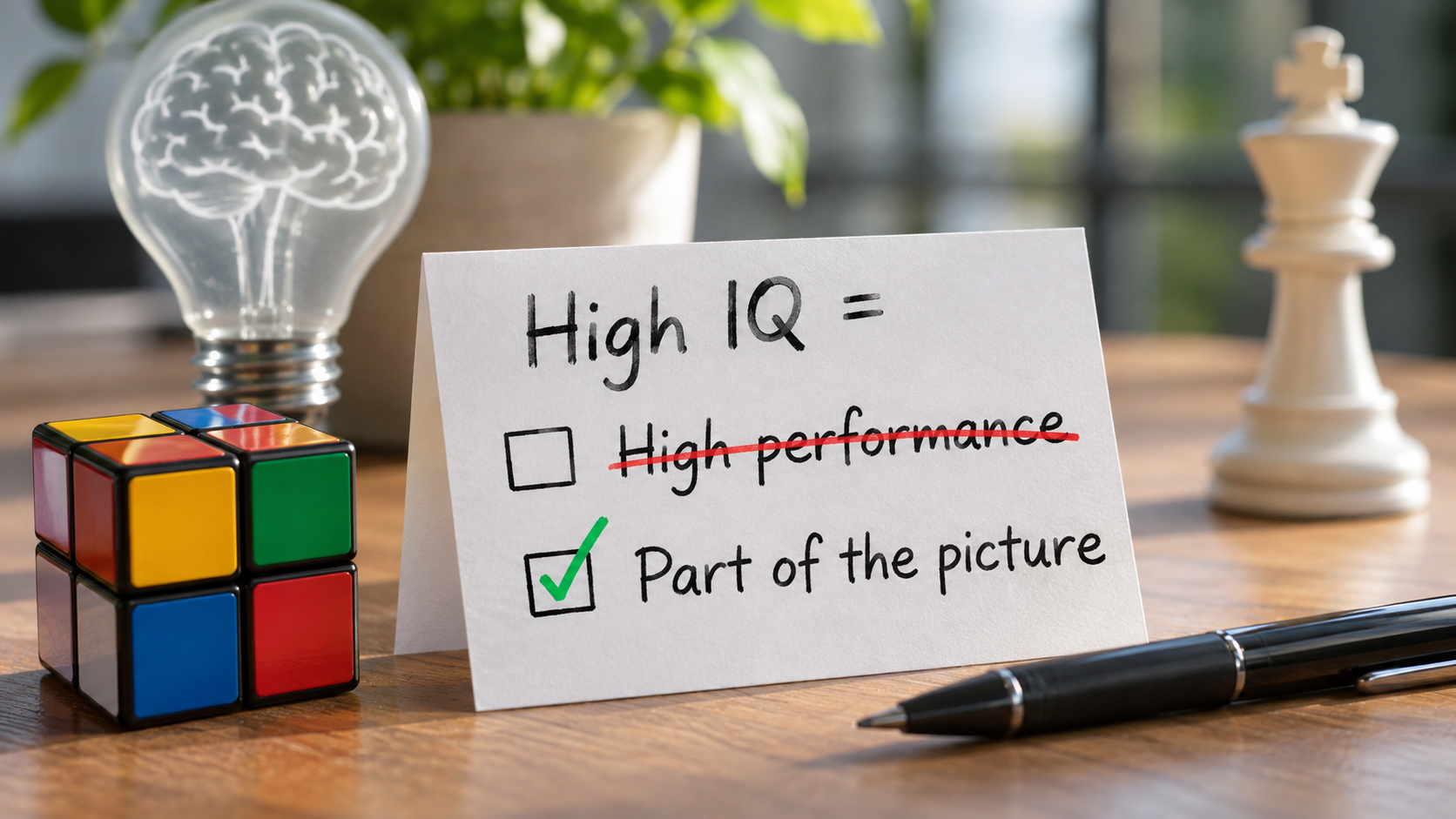
A new study published in August 2026 challenges one of the most widely accepted ideas in employee selection.
Imagine two candidates applying for the same job.
The first learns quickly, solves problems easily, and gets an excellent score on an intelligence test.
The second gets a lower score.
Who would you hire?
For decades, research in organizational psychology has suggested that the first candidate is more likely to perform well at work.
But how much more likely?
And how accurately can an intelligence test really predict someone's future performance?
A new study suggests that we may have been overestimating the answer.
What did we believe for years?
In 1998, Frank Schmidt and John Hunter published one of the most influential studies in organizational psychology.
Their research showed that general mental ability (GMA), often measured through cognitive ability tests, was one of the strongest predictors of job performance.
The reported validity coefficient was approximately 0.51.
In simple terms, there was a fairly strong relationship between how well someone performed on a cognitive ability test and how well they performed at work.
This finding influenced recruitment and assessment practices around the world for almost three decades.
And for good reason. Companies want to make better hiring decisions, and scientific evidence helps them do that.
But science never stops asking questions.
What does the new research tell us?
In August 2026, researchers including Paul Sackett and Christopher Nye published a new study in the Journal of Business and Psychology.
They analyzed evidence from 212 samples, covering 109,396 people, using research data collected between 1990 and 2022.
Their estimated relationship between general mental ability and job performance was approximately 0.20.
That's quite a difference.
From 0.51 to 0.20.
To put this into perspective, a correlation of 0.20 corresponds to approximately 4% of the variation in job performance being statistically explained by cognitive ability, under a simple linear interpretation.
This does not mean intelligence tests are only 4% accurate.
It means that the relationship between cognitive ability and job performance may be considerably weaker than the traditional estimates suggested.
And that's something worth discussing.
Why such a big difference?
There are several possible explanations.
First, the way researchers calculate and correct validity estimates matters. Some statistical adjustments used in earlier research may have produced estimates that were too high.
Second, the evidence available today is different from the evidence used decades ago.
And third, job performance itself is complicated.
Think about a manager.
They may be extremely intelligent, understand complex information, and solve difficult problems.
But what happens if they cannot listen to their team?
What if they avoid difficult conversations?
What if they struggle to motivate people or manage conflict?
Being intelligent does not automatically make someone an effective manager.
The same applies to sales.
Someone may understand a product perfectly but still struggle to build relationships, handle rejection, or negotiate with customers.
Knowing something and being able to do something are not always the same thing.
Of course, these examples help explain why performance is complex. They do not, by themselves, explain the statistical difference between the two research estimates.
Does this mean intelligence no longer matters?
Absolutely not.
The ability to learn, understand information, and solve problems remains valuable.
Cognitive ability tests can still provide useful information when making hiring decisions.
But they tell us only part of the story.
They cannot, on their own, tell us everything about someone's motivation, personality, interpersonal skills, or behavior in challenging situations.
And that's why selecting people should rarely come down to a single score.
Depending on the job, companies may benefit from combining different sources of information, such as structured interviews, personality assessments, work samples, and Assessment Centers.
Not because these methods are automatically better than cognitive tests.
But because they can help us understand different aspects of a person's suitability for a role.
The important question is not simply which test has the highest score in a research paper.
It's whether we are measuring the things that actually matter for the job.
What should companies take away from this?
I believe there are three simple lessons.
First, don't expect one test to tell you everything about a person.
Even a scientifically validated assessment has limitations.
Second, start with the job, not the assessment.
Before evaluating candidates, we need to understand what successful performance actually looks like in that particular role.
Third, stay open to new evidence.
What we believed 20 or 30 years ago may need to be reconsidered when better research becomes available.
And that's not a weakness of science.
That's exactly how science is supposed to work.
Final thoughts
What I find most interesting about this study is not that intelligence tests may predict less than we once believed.
It's that researchers are willing to challenge conclusions that have shaped an entire industry for decades.
The new findings do not mean we should stop using cognitive ability tests.
They mean we should be more careful about what we claim those tests can predict.
Because at the end of the day, a person is more than a test score.
And job performance is more complicated than any single number can explain.
Research reference
Demeke, S., Sackett, P. R., Nye, C. D., Li, Y., & Kuncel, N. R. (2026). Is General Mental Ability Still the Best Predictor of Job Performance? Integrating Contemporary Meta-Analytic Evidence. Journal of Business and Psychology.
https://doi.org/10.1007/s10869-026-10146-8
Global Test Consultants | Profiles International Partner – Romania, Bulgaria & Republic of Moldova