
How Much Does an Assessment Center Cost—and How Do You Choose the Right Methodology?
When planning an Assessment or Development Center, one of the first questions is usually: How much will it cost?
The honest answer is that there is no universal price. The cost and structure depend on the role being assessed, the number of participants, the competencies involved, the assessment methods selected, and the type of deliverables required.
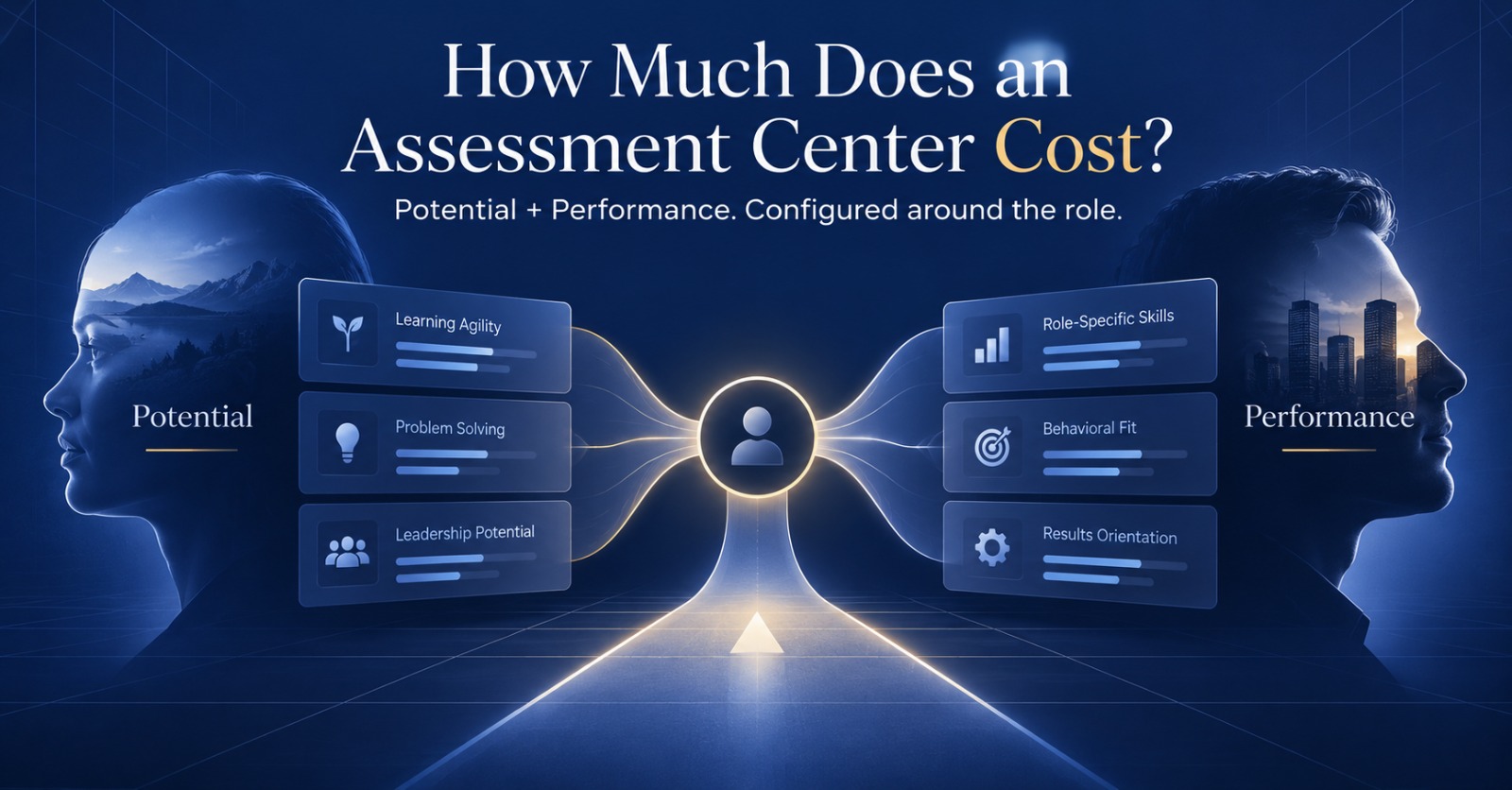
A well-designed Assessment Center is not simply a collection of exercises. It is an integrated evaluation process that combines information about a person’s potential with observable evidence of performance.
To make the initial planning process easier and more transparent, Global Test Consultants has developed an online Assessment & Development Center Configurator. The tool enables HR professionals and business leaders to explore different methodologies and receive an immediate indicative project estimate.
Potential and performance: two complementary perspectives
An effective assessment process should help answer two different questions:
What can the person bring to the role?
Psychometric assessments provide information about potential, motivation, behavioural style, cognitive abilities, and compatibility with the requirements of a specific position.
Depending on the role and purpose of the project, the assessment may include:
- PXT – evaluates thinking style, behavioural traits, occupational interests, job fit, and development potential;
- PSA – identifies sales potential and the factors that may support or limit commercial performance;
- CSP – evaluates the characteristics associated with consistent and valuable customer service;
- PPI – describes behavioural style and the way a person is likely to work, communicate, and collaborate.
These tools help organisations understand the underlying characteristics that influence how someone may approach a role. However, potential alone does not provide the complete picture.
What does the person demonstrate in realistic business situations?
Business simulations provide observable behavioural evidence. Participants are placed in situations relevant to the target role, while trained assessors evaluate how they analyse information, make decisions, communicate, collaborate, influence others, and manage priorities.
An Assessment or Development Center may include:
- In-Basket / In-Tray Exercise – evaluates prioritisation, analysis, planning, judgement, and decision-making;
- Role Play – explores influencing, negotiation, communication, and the management of difficult conversations;
- Group Exercise – provides evidence regarding collaboration, contribution, influence, and leadership within a team;
- Competency-Based Interview – examines relevant past behaviours through a structured, evidence-based interview;
- Analysis and Presentation Exercise – evaluates analytical thinking, business or commercial perspective, recommendations, and executive communication.
The strongest assessment processes combine psychometric information with evidence gathered from simulations. This creates a more balanced view of both what a person may be capable of and what the person actually demonstrates in situations that reflect the demands of the role.
Why there is no standard Assessment Center package
Two organisations may assess the same number of participants and still require very different projects.
For example, an Assessment Center for sales managers may place greater emphasis on commercial judgement, negotiation, customer orientation, and people management. A project for senior executives may focus more heavily on strategic thinking, decision-making, change leadership, and executive communication.
The methodology should therefore be selected according to:
- the purpose of the project: selection, promotion, succession, or development;
- the level and complexity of the role;
- the competency framework;
- the number of participants;
- the number and type of exercises;
- the number of assessors required;
- the expected reports and feedback sessions;
- the time available for preparation and delivery.
This is why calculating the cost only by multiplying the number of exercises by the number of participants can be misleading. A complete project also involves design, preparation, coordination, assessor time, integration of results, reporting, and project calibration.
What should be included in an Assessment Center estimate?
Before comparing proposals, it is important to check what is actually included in the price.
A comprehensive project may cover:
- project design and preparation;
- review or development of the competency matrix;
- selection and adaptation of assessment exercises;
- scoring sheets and behavioural indicators;
- participant scheduling and project coordination;
- a team of trained assessors;
- administration of psychometric tools and simulations;
- integration and calibration of assessment results;
- individual reports;
- a consolidated team report;
- individual feedback sessions;
- a management debrief or calibration meeting.
Not every project requires all these components. However, they should be discussed from the beginning so that the estimate reflects the complete scope of work rather than only the visible assessment activities.
Configure an indicative project in a few minutes
The Global Test Consultants configurator allows you to create an initial Assessment or Development Center structure based on your project requirements.
You can:
- enter the role and number of participants;
- select the psychometric assessments relevant to the project;
- choose the business simulations you want to include;
- add individual feedback and a consolidated team report;
- receive an indicative cost range, updated in real time.
The result is not a contractual offer. It is a practical starting point that helps you understand the possible structure, duration, and budget of the project before discussing the final design with a consultant.
From an indicative configuration to a valid assessment process
Technology can simplify initial planning, but the quality of an Assessment Center still depends on professional judgement.
The final methodology should be calibrated against the role, the organisation’s competency framework, and the decisions that will be made using the results. Exercises must generate relevant behavioural evidence, while assessors need clear indicators and a consistent scoring process.
The configurator therefore provides orientation and transparency—not a one-size-fits-all solution. Once the initial configuration has been created, it can serve as the basis for a focused discussion about objectives, methodology, logistics, and deliverables.
Would you like to explore what an Assessment or Development Center could look like for your organisation?
Configure your project and receive an indicative estimate
The estimate generated by the configurator is indicative and does not represent a contractual offer. The final structure and budget are confirmed after the project requirements have been discussed and calibrated with a Global Test Consultants consultant.