
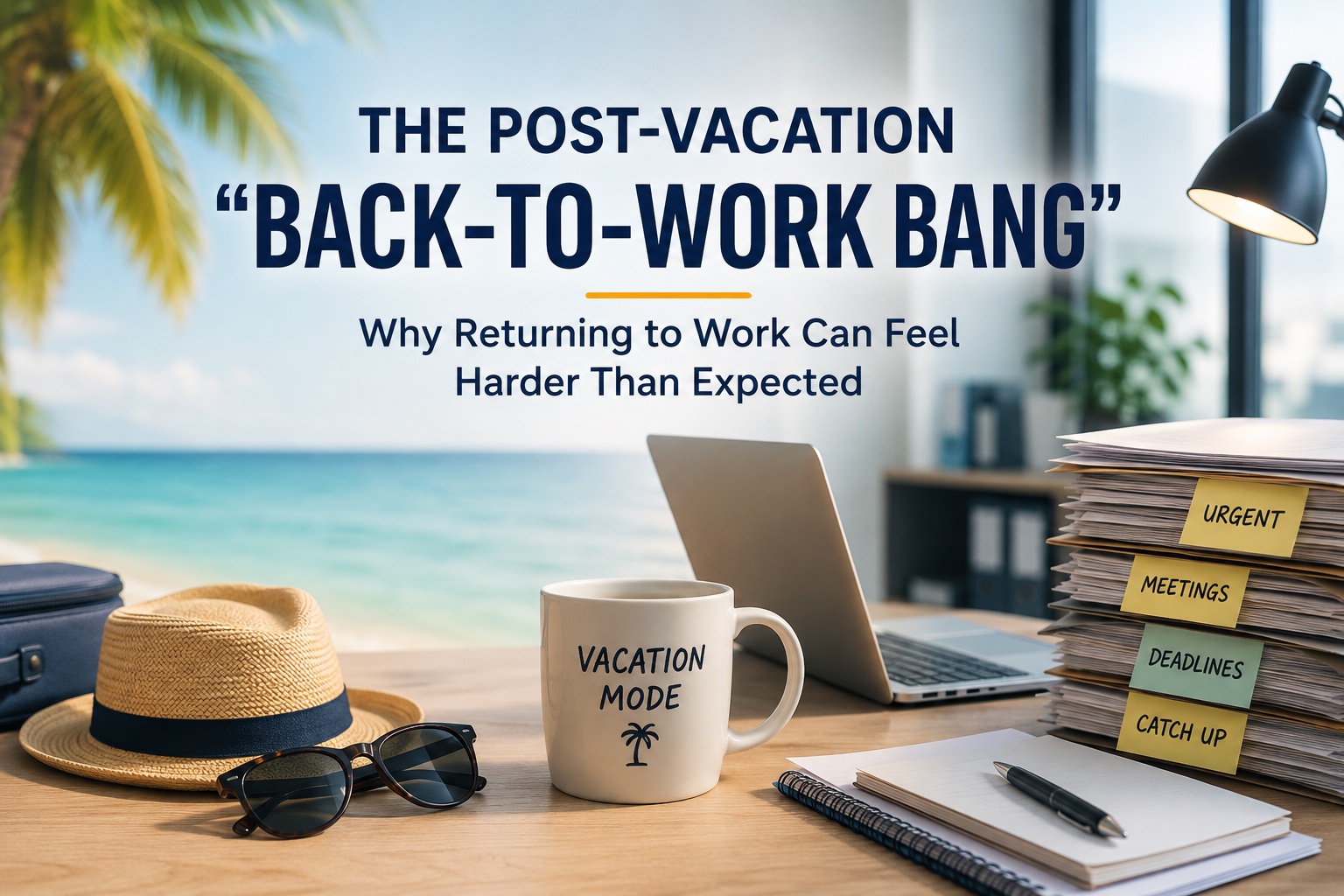
Summer holidays are supposed to help us disconnect, recharge and return to work with renewed energy.
And, for the most part, they do.
Yet for many employees, the final days of a holiday come with a familiar feeling: thoughts about the overflowing inbox, unfinished projects, upcoming meetings and the inevitable question:
“What happened while I was away?”
Returning to work after a holiday can bring stress, anxiety, difficulty concentrating or simply the feeling that we need a few days to get back into our normal rhythm.
Research suggests that this adjustment process is very real.
Holidays work – but their benefits can disappear surprisingly quickly
A meta-analysis conducted by Jessica de Bloom and colleagues examined seven studies on the effects of vacation on employee health and well-being.
The findings were encouraging: vacations had a positive effect on health and well-being, with an average effect size of d = 0.43.
The less encouraging finding?
Those benefits tended to fade relatively quickly once people returned to work.
The researchers identified a post-vacation fade-out effect of d = -0.38.
In other words, taking time off works. The challenge is maintaining some of those benefits once work resumes.
“Lots of fun, quickly gone”
A longitudinal study by de Bloom and colleagues followed 96 employees over seven weeks: before their holiday, during it and at several points after returning to work.
During the vacation, employees reported improvements in several areas, including health status, mood, tension, energy levels and satisfaction.
But the researchers discovered something striking:
During the first week back at work, health and well-being had generally returned to pre-vacation levels.
The authors captured the phenomenon perfectly in the title of their study: “Lots of fun, quickly gone.”
So the issue is not whether vacations help us recover.
They clearly can.
The more interesting question for organisations is:
What happens when employees come back?
The “Back-to-Work Bang”
Perhaps the most directly relevant research comes from Cátia Sousa and Gabriela Gonçalves.
Their study has a particularly memorable title:
“Back to work bang! Difficulties, emotions and adjustment strategies when returning to work after a vacation.”
The researchers conducted 93 semi-structured interviews to understand what employees experience when they return from holiday.
They identified several categories of difficulties, including:
- Work-related difficulties – returning to routines, schedules and accumulated workload;
- Social difficulties – reconnecting and readjusting to colleagues and the organisational environment;
- General difficulties – including tiredness and having less time for family or personal activities;
- A temporary feeling of disconnection from work or the organisation.
The study also identified both positive and negative emotions associated with returning to work.
For some employees, the transition can include stress, worry, difficulty concentrating and anxiety about the workload waiting for them or about what happened while they were away.
It is important, however, not to automatically treat post-vacation anxiety as a clinical diagnosis.
For many people, it is better understood as a temporary adjustment response to the sudden return of professional demands, routines and responsibilities.
Why can returning to work feel so difficult?
During a holiday, almost everything changes.
We may wake up later. Our schedules become more flexible. We spend more time with family and friends. We have greater autonomy over how we use our time. We make fewer work-related decisions.
And, ideally, we stop thinking about work altogether.
Then, on one particular morning, everything switches back.
Inbox. Meetings. Deadlines. Decisions. Problems that appeared while we were away.
The contrast can be significant.
And this is where organisations – and particularly managers – can make a difference.
What can managers do during the first 3–5 days?
Supporting employees after a holiday does not require an elaborate wellbeing programme.
Sometimes a few simple management behaviours can significantly improve the transition.
1. Don’t turn the first day back into an endurance test
Whenever possible, avoid filling an employee’s first day back with meetings, deadlines and major decisions.
People need some time to understand what happened while they were away and rebuild their mental map of priorities.
A little breathing room can make the transition significantly easier.
2. Provide context, not just tasks
One source of anxiety when returning from holiday is uncertainty.
What happened? What changed? What needs attention? What is genuinely urgent?
Instead of expecting someone to reconstruct two weeks of organisational activity from 150 emails, a manager can often provide the essential context in a short conversation.
Fifteen minutes of clarity can save hours of unnecessary stress.
3. Help people prioritise
After two weeks away, almost everything can look urgent.
Usually, it isn’t.
One of the most useful conversations a manager can have with someone returning from holiday is surprisingly simple:
“What are the two or three things that really matter this week?”
Prioritisation reduces cognitive overload and helps employees regain a sense of control.
4. Accept that productivity isn’t an on/off switch
We don’t instantly move from “vacation mode” to peak performance.
Research on vacation recovery shows how quickly improvements in well-being can disappear after work resumes.
Allowing employees some time to readjust does not mean lowering performance standards.
It means managing energy and performance realistically.
5. Don’t punish people for actually disconnecting
If we want employees to recover during their holidays, we need to allow them to genuinely disconnect.
An employee who doesn’t know everything that happened while they were away isn’t necessarily disengaged.
They may simply have done exactly what a holiday is supposed to allow them to do:
Switch off from work.
And the ability to recover matters for sustainable performance.
Holidays aren’t the problem. The return might be.
Organisations invest significant resources in engagement, wellbeing, leadership development and retention.
Yet employee experience is often shaped by much smaller moments.
Including what happens on a Monday morning after two weeks away.
The research gives us two messages at the same time:
Holidays are good for us.
And:
Their benefits can fade surprisingly quickly once we return to work.
Perhaps the goal of a good manager shouldn’t be to make employees catch up with everything they missed on their very first day.
Perhaps it should be to create the conditions in which people can gradually regain their rhythm, clarity and energy.
Sometimes, that requires little more than a few days of good leadership.
Research & References
de Bloom, J., Kompier, M., Geurts, S., de Weerth, C., Taris, T. & Sonnentag, S. (2009).
Do We Recover from Vacation? Meta-analysis of Vacation Effects on Health and Well-being.
Journal of Occupational Health, 51(1), 13–25.
https://doi.org/10.1539/joh.K8004
de Bloom, J., Geurts, S. A. E., Taris, T. W., Sonnentag, S., de Weerth, C. & Kompier, M. A. J. (2010).
Effects of vacation from work on health and well-being: Lots of fun, quickly gone.
Work & Stress, 24(2), 196–216.
https://doi.org/10.1080/02678373.2010.493385
de Bloom, J., Geurts, S. A. E. & Kompier, M. A. J. (2013).
Vacation (after-) effects on employee health and well-being, and the role of vacation activities, experiences and sleep.
Journal of Happiness Studies, 14, 613–633.
https://doi.org/10.1007/s10902-012-9345-3
Sousa, C. & Gonçalves, G. (2021; first published online in 2019).
Back to work bang! Difficulties, emotions and adjustment strategies when returning to work after a vacation.
The International Journal of Human Resource Management, 32(10), 2242–2263.
https://doi.org/10.1080/09585192.2019.1602784